
Where the Work Needs Us to Go
Leadership as the Practice of Understanding How People Need to Be Led

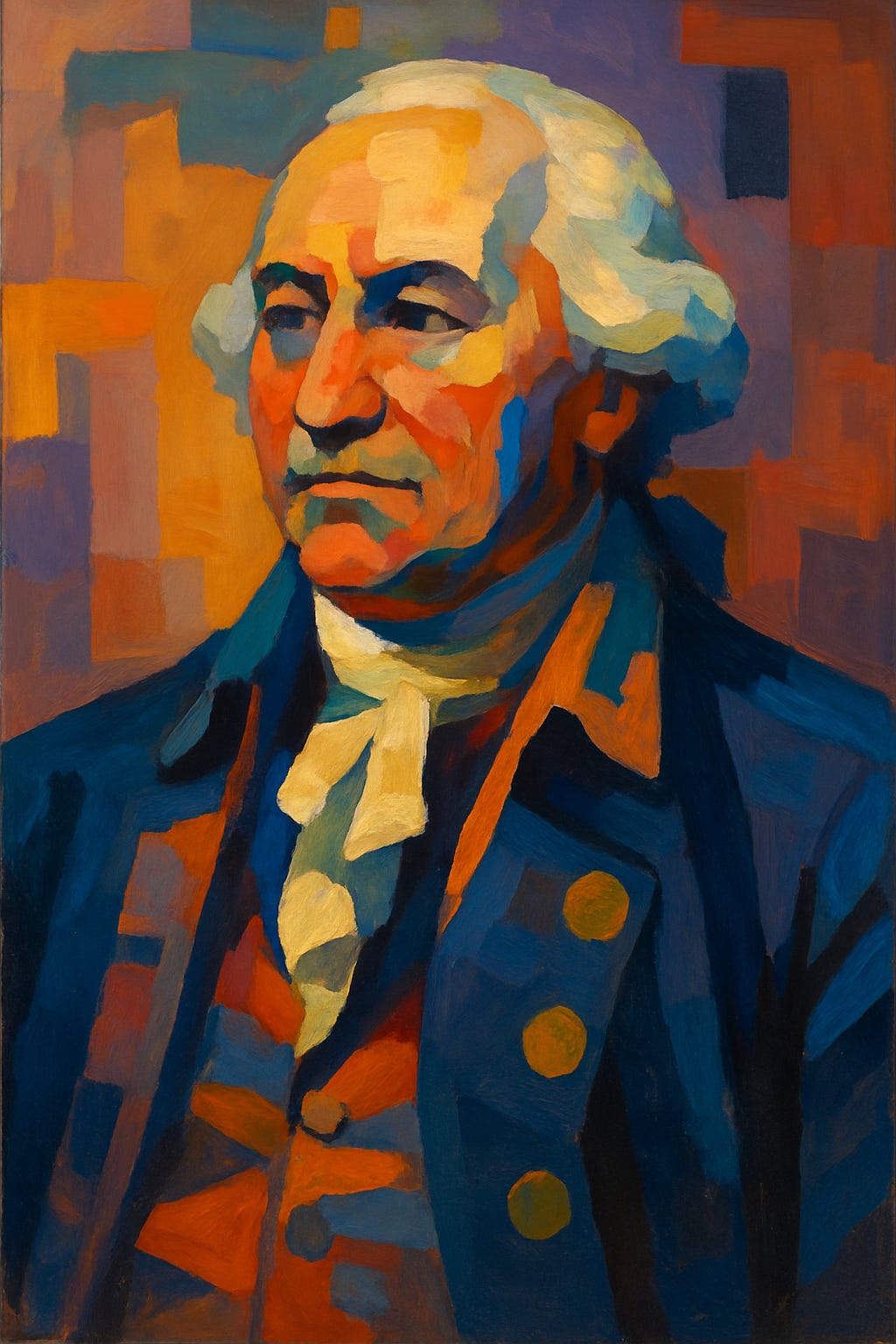
(This is part of the ongoing Resilience Series. You can read the first installment, The Upside of Collapse, here and the more recent piece on Feedback here)
I’ve been watching Ken Burns’ The American Revolution1 OK, fine, watching isn’t totally accurate. I’ve been living with it. I put it on while I cook. While I drive. Sometimes I put a single AirPod in and doze off listening to it, only to start an episode over again because I want to catch every thread I missed. I sent a picture to a friend of me running on my treadmill with it on in the background. It was every bit a middle aged dad moment: watch a PBS documentary while working out during my designated 45 minutes of free time before dutifully returning to my parental responsibilities.
Burns’ pacing is the antithesis of so much of what we are conditioned to expect from our content. It refuses to be sped up or watered down so it can fit neatly into a reel. Instead, it seeps in and settles around you like the break you didn’t know you needed but are grateful you finally took. It is its own kind of antidote to the age of brevity and superficiality. And I can’t get enough of it.
But it was Episode 5: The Soul of All America — covering the stretch from December 1777 to May 1780, the long, brutal arc from Valley Forge through the Battle of Monmouth and beyond — that pulled me into something deeper.
There’s a moment in that episode, almost easy to miss if you aren’t tuned to it, when a Prussian officer named Friedrich Wilhelm von Steuben steps into the story. Maybe I’d learned his name once in a schoolbook somewhere, but who he was, how he arrived, what he understood — none of that had taken root, until now
And in characteristic Burns fashion, it wasn’t a reenactment or even narration that brought him into focus. It was von Steuben’s own letters written to friends and acquaintances — read aloud over long, lingering shots of the Valley Forge encampment. In those letters, you hear him trying to make sense of these raw, undisciplined soldiers who, in his words, carried “a remarkable spirit but no discipline.”
Then came the line that made me pause the episode: von Steuben realized quickly that American soldiers did not blindly follow orders. They wanted to understand what they were doing and why.
I rewound. Listened again. And then … I went deeper.
“Baron” von Steuben didn’t come to America triumphant. Europe had run him off the continent. He was a Prussian officer, trained under Frederick the Great, but he also had enemies, debts, and something more dangerous: rumors of relationships with younger men. Today, historians agree that von Steuben was almost certainly a gay man navigating the danger of being himself in a century with no safe harbor for that truth. The rumors forced him out. A brilliant career derailed by suspicion, shame, and small-mindedness.
When he crossed the Atlantic, he came seeking a chance to begin again. And here’s the part that says a lot about George Washington: he knew. Ben Franklin, who recruited him, also knew. As did the fledgling Continental Congress who signed off on his appointment (unofficially) as Inspector General of the Army. It wasn’t like rumors didn’t travel across oceans even in the 18th Century. But Washington, Franklin and the others didn’t treat the man as a liability.
General Washington met von Steuben, and saw capability and discipline, and he trusted the man with his army. Sometimes, leadership begins there—in the ability to see talent without requiring that the person carrying it first prove they are safe.
But before we give the good General too much credit, let’s name the state of affairs, because it wasn’t as if von Steuben was stepping into a choice role that others were vying for. When he arrived at Valley Forge in February 1778, he confronted what could really only be described as catastrophe. Men were barefoot in the snow. Disease swept through the camp. Supplies were uncertain. Congress hadn’t paid its soldiers in forever. Morale, as one can imagine, was subterranean. And then there was the conduct of the army itself. Regiments drilled differently. Officers weren’t aligned in their responsibilities. Desertion was a steady undercurrent. Mutiny had to be put down with extreme force.
Honestly, this wasn’t an army.
Von Steuben got to work the way any of us would when given a monumental task and driven by the urge to show we are worthy. He figured he could overwhelm the men with discipline but soon discovered that the standard Prussian methods did not work here. When he issued an order, instead of crisp obedience, he got questions. Challenges. Puzzlement. Pushback. These men wanted explanations. They needed the why as much as the what.
At first, the experience frustrated him. In one of the letters quoted by historian Paul Lockhart in The Drillmaster of Valley Forge, von Steuben captures the contrast with the soldiers he had known in Europe: “In Europe, you say to your soldier, ‘Do this,’ and he does it. But I am obliged to say to the American, ‘This is why you ought to do this,’ and only then does he do it.”
Right there, in his own words, you can see the seeds of a shift. A Prussian officer, trained in one of the most rigid armies in the world, reevaluating his techniques, and the underlying cultural logic of the people in front of him.
What von Steuben realized he was encountering at Valley Forge wasn’t insolence or incompetence, though I am sure there was plenty of both. He was witnessing the origins of a democratic temperament, a deep, abiding belief in personal reason, and a sheer refusal to surrender agency without understanding.
And what he decided to do may have been the most consequential leadership move someone in his position could have made: he chose to adapt.
He replaced barked commands with explanations. He broke complex maneuvers into logical pieces. He taught officers how to teach. But what he was really doing all the while was treating questioning as a legitimate part of learning instead of a threat to authority. He didn’t break their independence. He gave it shape.
And as a result, as the snow gave way to spring, something in the camp began to lift its head.
Washington took notice. He saw the coherence forming, the morale shifting, the men responding. And rather than feel threatened by von Steuben’s growing influence, he made yet another crucial leadership move: he resourced him.
As the refreshed army readied for spring, the General sent his rising star to Philadelphia to write a new instructional manual with a small but remarkable team:
Pierre Etienne Duponceau, a brilliant young linguist
Benjamin Walker, von Steuben’s trusted aide
François de Fleury, the decorated French engineer
Pierre Charles L’Enfant, the artist-engineer who would later design Washington, D.C.
While the war raged, Washington created a multilingual, multi-modal knowledge-production team around a man the rest of Europe had rejected. Think about that. He put the fate of the new country—not yet a nation—in the hands of a man who had been shunned.
I can almost see the epic movie montage: the bustle of Philadelphia in the birth throes of a republic, streets alive with debate and ink-stained drafts crossing desks in every direction. Von Steuben wrote in French. Duponceau sharpened it. Another officer translated it into English. Washington himself tightened the words into military precision. And L’Enfant sketched the images that made sense of it all.
The result — Regulations for the Order and Discipline of the Troops of the United States, nicknamed the Blue Book for its blue paper-covered boards — became the first coherent American military system. Almost three thousand copies rolled off the presses in March of 1779. In about 150 pages, it standardized drill and clarified roles. It gave the army a shared vocabulary. A way of moving and thinking together that didn’t depend on blind obedience. And perhaps most importantly, it explained the why behind the how.
The effects were unmistakable: Desertions dropped. Reenlistments rose. Confidence returned. Identity formed.
Men who had openly questioned why they should fight for wealthy planters who refused to enlist stayed. I won’t go so far as to say the Blue Book alone changed their minds, but there’s no disputing that, for the first time, they understood the system they were part of.
But let’s pause and rewind.
Before the Blue Book spread his system across the army, the men who had learned from von Steuben in person carried those lessons into the first test of the winter’s work: Monmouth
Picture the scene. June 1778. Hot, exposed ground. A battle that arrived more quickly than expected. The first real test of whether the winter’s work would matter.
At the start, things fell apart. Orders were confused. Movements broke down. The British pressed hard, and despite the expectation of a new fighting spirit, it suddenly looked as though all the drilling and new structure might collapse under the weight of real combat.
And then Washington reached the field. The lore around his arrival is the stuff of legend. The man of destiny appears on the battlefield. Von Steuben had done the hard work of shaping the army’s structure, but he was not the commander who could rally them by sheer force of presence. Washington was. His arrival steadied the line. Officers regrouped. The men drew on the patterns they had learned in the snow — the formations, the timing, the shared language von Steuben had taught with relentless care. Slowly, the army recovered its footing.
The battle was inconclusive. No one won. But the real shift was in how the Americans fought: steadily, coherently, without losing themselves in the chaos. They held their ground. They refused to break. They looked, for the first time, like a unified force.
Monmouth wasn’t a triumph by the traditional measures of war, but in every way that mattered, it was a victory.
Here’s where all of this history has led me: Leadership is the practice of understanding how the people in front of you need to be led in order to get where the work requires them to go.
Not where the leader wishes they would go. Not where the leader’s past experiences tell them to go. Where this moment, this culture, and these people require them to go.
Britain failed because it tried to direct a war from across an ocean and believed loyalty could be bought from anyone willing to serve for coin. Von Steuben succeeded because he read the people he was trying to serve. Washington succeeded because he trusted the person who could see and do what he could not. Together, they made adaptive leadership visible. An army became a unified body because one leader took the time to understand who was standing in front of him and another had the wisdom to let him lead.
This is exactly what resilient systems do: They adapt. They learn. They transmit knowledge intentionally, inclusively, coherently.
The Blue Book spread and became almost biblical in the military because it is a resilience document. A cross-language, cross-role, cross-competency consolidation of knowledge that made collective action possible. This is Pillar 3 of the Resilience Framework I’ve been developing: Knowledge Consolidation and Transmission. They took scattered insight, translated it across languages and roles, and embedded it in a system people could understand across place and time.
Winning, as Burns tells it—and as I believe—isn’t clean. It’s not glamorous. It doesn’t always look like triumph. Winning involves losing. Learning from losing. And, more importantly, building systems that help people understand themselves anew.
Because if there is anything I have discovered during my season of studying resilience, it’s that it is less about strength than it is about understanding. Understanding people. Understanding culture. Understanding what it takes for human beings to move together toward a future they can only reach collectively.
Von Steuben saved the army and perhaps the war by recognizing the American character, not by suppressing it.
And that leadership lesson—born in a winter of hunger and desperation—still stands.
Take the Epstein files. I’m not drawn to them personally. But I can’t ignore the intensity: the demand for truthfulness, the suspicion of secrecy, the belief that withheld information is a betrayal.
I don’t share the fascination, but I understand the instinct. It is the same instinct von Steuben encountered at Valley Forge. The same instinct Washington recognized. The same instinct that runs through American life: People want reasons (even if they are not always grounded in reality). People want honesty (or at least someone they can believe). People want to understand (in so far as it involves their interests).
I see it in every organization I enter. People aren’t asking questions to undermine leadership (okay, maybe a few are). By and large, they’re asking because understanding is what allows them to commit.
But too many leaders have become skilled at the performance of listening: we go on listening tours that change nothing. We roll out the open-door policy that opens nothing. We commission the survey and bury the results.
That isn’t resilient leadership. Resilient leadership is altering yourself in response to what you’ve learned. It’s recognizing that what worked elsewhere or yesterday may not work here or today. It’s understanding that rigidity is a precursor to collapse.
And the best leaders — whether directors, quarterbacks, teachers, organizers, or commanders — adapt the form to the people, not the people to the form.
Which, for me, is why von Steuben still matters. People don’t follow because we tell them what to do. People follow because we help them understand why it matters.
That was true in the winter of 1778. And it will be true as long as we keep trying to build something together in this questioning, unfinished, resilient country.
Although Burns is the lead name, he shares directorial credit with Sarah Botstein and David Schmidt
This is timely. It resonates. Nicely done