Growing Up Inside the Archive
Childhood amnesia once promised that early life would fade on its own. What happens when digital memory begins to interrupt the mercy of forgetting?

This is my last essay of the first half of the year, and in some ways it feels like the piece I did not know I was writing toward all along. Over these past months, I’ve been circling memory from different directions: the long past, the recent past, the country we once thought we knew and no longer quite recognize. Again and again, I’ve found myself asking how we hold time, how the past keeps changing inside us, and what it means to carry what we can no longer return to.
This essay brings that inquiry home, literally. It is a longer, more forensic piece than my usual reflections, heavily anchored in developmental psychology and neuroscience, yet entirely driven by a quiet crisis inside my own house. What started with a glance at a digital photo frame in our hallway became a personal odyssey into family grief, the biological mechanisms of childhood amnesia, and the radical ways digital technology is changing the mercy of forgetting.
For parents navigating this hyper-documented era, and for anyone wondering how the machines on our walls are shaping who our children believe they are, I hope you’ll read and share this deep dive.
See you on the other side,
DDR
I. The Rushed Exit
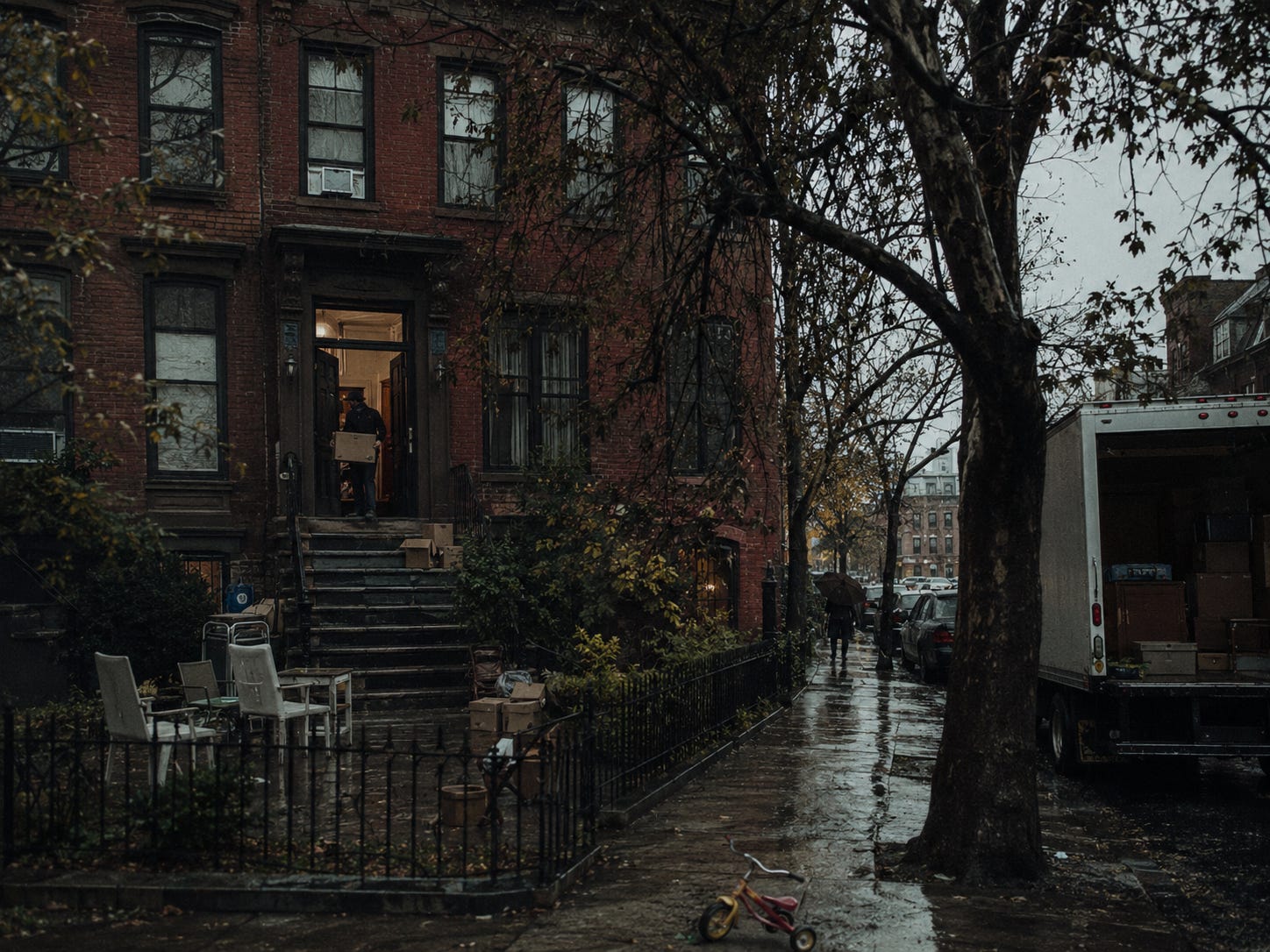
The rain wouldn’t stop and the clouds wouldn’t budge. It was one of those mornings that just never quite announced itself. By eight o’clock, the movers were already inside, their wet books squeaking across floors and marching up and down stairs. Four men packed and wrapped with militant efficiency, only exchanging words when necessary like when it came to maneuvering the oblong couch down a narrow stairwell.
It had been a good home to be trapped inside for eight months. Two floors. A living room and dining room. A narrow strip of front yard the primary purpose of which became holding the trash cans we dumped wine bottles in. A cramped backyard patio that I’d turned into a morning meditation space. We’d had more than many. Space to retreat from one another. Space to find each other again.
It was our first home together. The house where we celebrated our marriage with friends and family after a surprise elopement in Sedona. The house where, just a few months later, we brought our Ella home. The house where, during those frantic first months of COVID, fear and gratitude trauma-bonded on Fridays to D-Nice spinning records on IG. And now it was a shell again.
I imagine most people, on their last day in a city they had spent two decades trying to belong to, might choose something more cinematic. One last stroll. One last coffee. A reflective moment on a favorite corner. I mostly remember moving from one room to the next trying to stay out of the way. I’d already returned the cable boxes and router to the cable company so I tethered my laptop to my phone and took calls.
Once everything had been cleared out and packed in a truck bound for DC, I recall sitting on a windowsill in the room we had slept in for the past three years looking out onto Empire Boulevard one last time. Three months earlier the street had been the home base for assorted 50 person BLM protests. One night I looked out and saw a car ablaze. The fire department eventually doused it but the burnt shell remained for days, hoarding a coveted parking spot on an already too crowded street.
I wish I could say I understood the moment in the moment. I just don’t think I was capable. I understood that ambulance sirens had become part of the neighborhood’s soundtrack and death counts had become part of the daily news cycle. Reporting a piece for The Guardian earlier that year, I had spent weeks talking to exhausted and overwhelmed funeral home directors, documenting a reality that seemed impossible even as it was happening. Bodies stacking inside refrigerated trucks. Zoom funerals. Folks not being able to say goodbye to loved ones because of pandemic protocols.
By fall, I was ready to leave New York. Escape is actually the word that comes easiest to mind. We were getting out in the middle of a crisis, and we weren’t the only ones. An exodus was well underway. People were decamping left and right. Some were buying homes while others were crashing with friends and family, or just leading a nomadic existence in the interregnum.
The strange thing is that leaving felt both entirely natural and extraordinarily abrupt. At the beginning of 2020, we had never thought about leaving. Even in the middle of 2020, we imagined we would wait out the pandemic. Then, in what felt like the span of a few weeks, we found a house, secured a mortgage, signed the paperwork, packed our belongings, and left.
There was no grand deliberation. We just decided and then kept making the next decision. It was all kind of an out of body experience. Then one rainy evening we left one empty house and entered a different empty house the next morning. The truck arrived and within a couple of hours tables appeared, bookshelves filled. The crib was re-assembled. The cable guy showed up and did his thing. When I discovered DC’s version of a bodega a mere two blocks from our new home, I took it as a sign—I may have left New York but nothing had really changed.
And then life accelerated. There were clients and books and podcasts and talks. Alana switched jobs. We made new friends and built new routines. Along the way, Xavier arrived. Then a new, unexpected branch of our lives flourished in a South Carolina beach town.
The years stacked themselves one on top of another. We both returned to New York frequently for work, but for me at least those trips were always utilitarian missions. Fly in. Do the meeting. Find the hotel closest to the work. Catch the earliest flight home. I didn’t linger or long. The children were so young that being away for an hour more than was necessary felt unfair. Plus, we were becoming a family and I didn’t want to miss any of the action.
Starting in 2021, we began returning to New York as holiday tourists, first pushing strollers through Midtown and taking pictures beneath the Rockefeller Center tree, now taking the subway to museums and climbing rocks in Central Park. The same activities I would have mocked mercilessly when I actually lived there became ritual. I found that I could finally take New York for what it was and not yearn for more.
Except, of course, when it came to the Knicks.
Even after the particulars of our Brooklyn life faded, after New York became mostly work trips and Christmas visits, the Knicks remained. And as each year passed, they continued to serve as a proxy for presence. A way of telling myself that the city still belonged to me and I still belonged to it. A way of pretending that time had passed without actually passing.
So when Alana and I returned to Brooklyn together for a wedding five and a half years after we left and for the first time without kids, I didn’t anticipate what awaited or started to unfold.
II. The Return

We got in on a Thursday afternoon and the wedding wasn’t until the next evening. Which meant we had a Friday in Brooklyn to ourselves. We looked at each other with the giddiness of people who had been temporarily released from captivity and were not entirely sure what to do with the run of the place.
Technically, we only had a few hours. But to us, it felt like all of time. Besides, we had experience making whole worlds out of tight windows in big cities. (Not that Brooklyn is a city. Brooklyn is a planet, obviously.) Shortly before Ella was born, we found ourselves with an overnight layover in Paris on our return from Morocco. So we booked a room in the city center, dropped our bags, and absorbed as much as the clock would allow. Nine months after Ella arrived, a weather related delay left us stranded in Mexico City for a night. Again we booked a room, parked bags, showered and sprinted. Again you can not convince my nervous system that I was only there for twenty hours. I can still summon specific moments from both cities with startling clarity. Finding an errant wedding ring along the Seine, then glancing over at the Eiffel Tower and being startled by its presence. The quality of late afternoon light on a Mexico City street outlining a busy roundabout. Tiny fragments of sound that somehow survived while entire years have grown hazy around the edges. Some places leave grooves deeper than their duration should allow. And I’ve come to believe that’s because time is a terrible measurement for experience.
The one thing I needed to do was get to Williamsburg. A tie I had ordered for the wedding had disappeared somewhere inside the modern logistics economy, and I needed the exact replica in order to perfect my wedding fit. So we got dressed and started walking toward Williamsburg.
That was the entirety of our plan.
We crossed Flatbush into Fort Greene and started up Fulton, moving slowly enough to let the old places announce themselves. There was BAM. There was the pizza shop we used to go to. There was the fish monger. There was the bar where I spent too many nights and too much cash. There was the Biggie mural.
At some point I checked Uber, and the price felt offensive. Then we saw the Citi Bikes waiting with the particular confidence of an obvious answer. We looked at each other. If we were in a comic strip, our thought bubbles would have both read “Why not?”
The sun was out. The breeze was soft. It was early May, which meant spring still had plenty of runway. We rode past the Navy Yard and through the industrial landscape, crossing into Williamsburg with that slightly ridiculous feeling that something so ordinary somehow sparks the recovery of lost memories. Years earlier, when we were first falling in love, riding bikes through Brooklyn had been one of our things. We’d ride to the Coney Island boardwalk or Brighton Beach with no particular destination in mind.
There is a specific pleasure in riding a bike through a city you once knew intimately. You know it in a way a visitor cannot and you see it in a way a dweller isn’t interested. You remember which streets bend, which intersections to avoid. And yet you no longer know it the way you once did. That is the fine line between discovery and rediscovery; between remembering and realizing there were things you never really saw when you lived there.
Every time I looked back and saw Alana behind me on the bike, I smiled. There she is, I thought. There we are. Here we are.
Inside a marriage, especially once children arrive, the original pair can start to feel oddly remote from one another. The whole architecture of the relationship changes once the endless logistics of keeping a family moving kick in. And then, once in a while, there is a day. A stupid, beautiful, stolen day set in motion by a quest for a tie. And suddenly you remember: “Oh right. Us.”

Later that afternoon, while Alana got ready for the wedding, I left the hotel and wandered by myself toward Gowanus without meaning to. What I found there shocked me. The pre-pandemic Gowanus I remembered was an off the beaten path home to factories, warehouses and a canal that occasionally gurgled up a dead body. Now dozens of residential towers erupted from the earth surrounding that thin strip of water to form a fortress of accessible luxury. Glass, steel, neutral palettes, and expansive windows surrounded me. They looked uncannily interchangeable, as if the same architectural idea had been copied and pasted across entire blocks. But what really caught my attention was the promise they were selling. Never leave. Parking problem: solved. Gym problem: solved. Workspace problem: solved. Hangout space: solved. They each promised their occupants upmarket amenities like courtyards, rooftops, and lounges priced in or available for an upcharge. This was an entire ecosystem of amenities arranged around the fantasy that the city could be enjoyed without actually having to encounter too much of it. Noise, inconvenience, exposure, strangers, friction — all of it shielded by security and design, managed by an invisible conglomerate whose margins relied on economies of scale.
I stood there trying to reconcile these towers with the Brooklyn I had carried in my head for the past 5 years. These buildings had not appeared overnight. Yet, I had missed them all. Fort Greene had fooled me because it still offered a familiar menu of brownstones and bric-a-brac intertwined with haute and history. Gowanus made plain what I had not wanted to know. Time had passed. Brooklyn had continued without me.
If I can trace the first pang to a particular moment, it was stepping out of the car where Ocean and Lincoln meet at the eastern perimeter of Prospect Park. Almost immediately, the memories gathered around me. During those first months of COVID, this was the place we went when even the little patch of earth we held legal rights over felt too small, when the news felt unbearable, when parenting a baby inside a crisis made the walls press in. Every morning, Ella and I would head down Empire and into the park before the day had fully begun. I packed blankets and snacks and bottles and sat beneath trees while she crawled around in the grass.
I remembered wandering there alone in the afternoons when I could not write and the sirens had become too much, hoping to submerge myself in some sliver of silence that might loosen the tangle of words in my head.
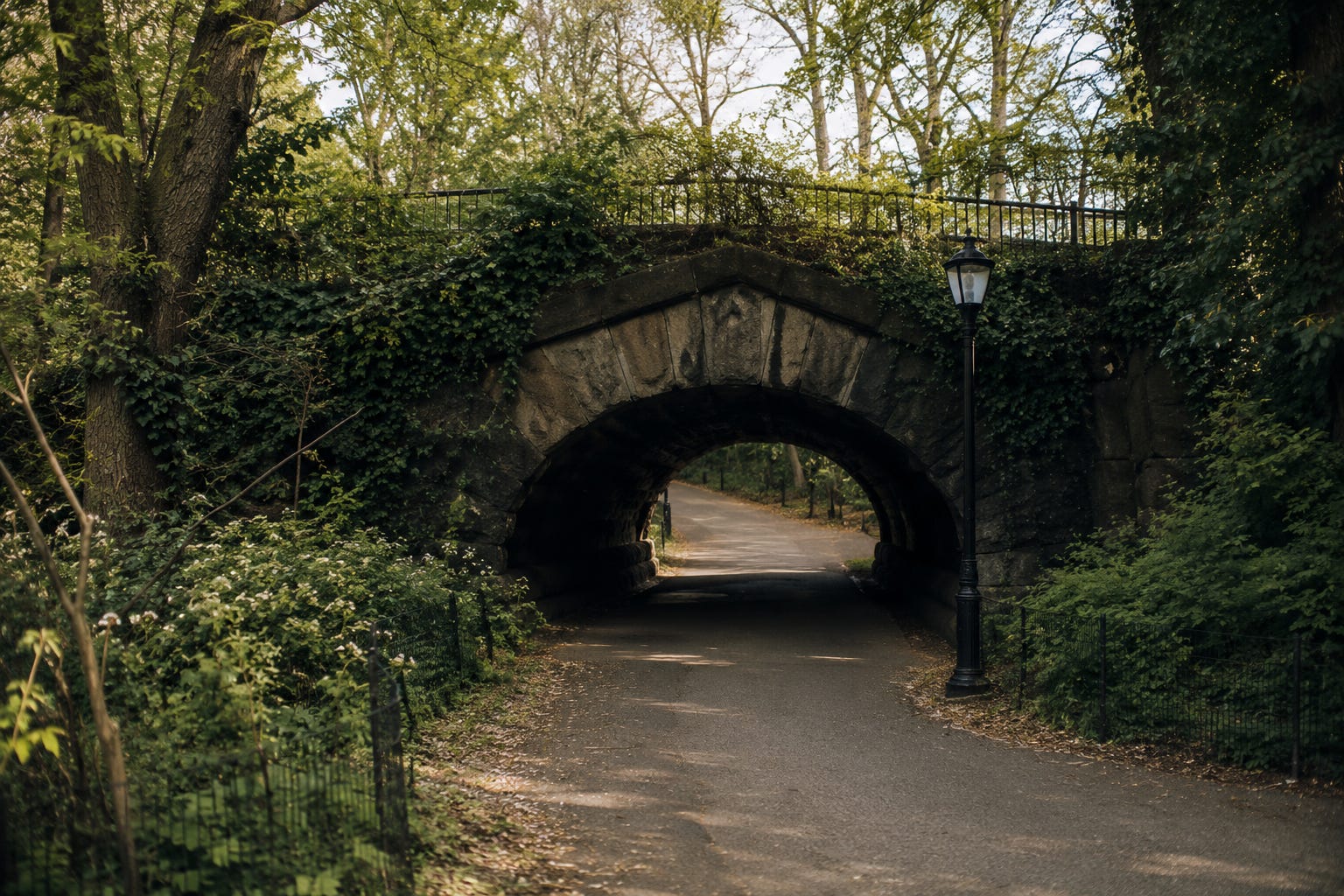
It occurred to me, walking through the cylindrical tunnel at the edges of which a silhouetted saxophonist serenaded strangers, that the park was a portal into a past life. The years stacked up so quickly that I could mistake them for a blur. But the park had kept its own time. It had stayed there with those mornings intact, or at least intact enough that when I returned, my body resuscitated those memories before I was able to shield myself from the grief. It recognized the paths. The grade of the hills. The cool of the tunnels. The way the light filtered through the trees.
But the grief wasn’t about wanting to undo my life or wishing I had stayed. It was weirder, more layered. I can only describe it as the ache of brushing up against another life that had kept going without me on some other earth. A life not better or worse, just different. Another version of us walking those paths, raising our children inside that borough, growing older with the park as part of the ordinary architecture of our days.

The wedding was at the Boathouse, and it would be hard to imagine a more perfect evening for it. The light shimmered through the trees in that golden early evening way that makes everyone look a little more glamorous than they have any right to look. The water moved gently behind the ceremony like a trusted witness. Strangers gathered on the Lullwater bridge just to watch and smile. At the conclusion of the ceremony, they clapped along with the invited guests as if the whole park and all of nature itself was blessing the marriage.
I ate. I danced. I laughed. I was happy to be there. But the other life hung out by the water all night. Five and a half years can be a blur in the life of a middle-aged man. A year passes. Then another. You look up and the baby has teeth, then opinions, then homework, then inside jokes you only half understand. But five and a half years in the life of a child is an era. When we left Brooklyn, Ella was eighteen months old. Which means, according to the ordinary math of adulthood, she barely lived there. A year and a half. Not even two birthdays. A flash. A prelude. New York was a place she passed through before memory wraps its arms around her.
But standing in Prospect Park that evening, I found myself wondering whether that math was wrong. She could not have understood the pandemic. She could not have understood why the streets had emptied, why sirens kept tearing through the neighborhood, why grown people crossed the street to avoid one another. But she could understand ritual. She could understand being lifted from her crib in the morning, buckled into the stroller, pushed down Empire Boulevard toward the trees. Maybe that is all a baby needs for a place to enter her. Maybe some experiences do not require duration to leave a mark. Maybe the only prerequisite to permanence is depth. Maybe, if the park still lived inside me this vividly, after all these years, part of it still lived inside her too?
That question was sitting on the edge of the bed when I woke up the next morning. It looked over my shoulder while I packed. Then it followed us to the car, strapped itself into the backseat, and rode with us all the way back to DC.
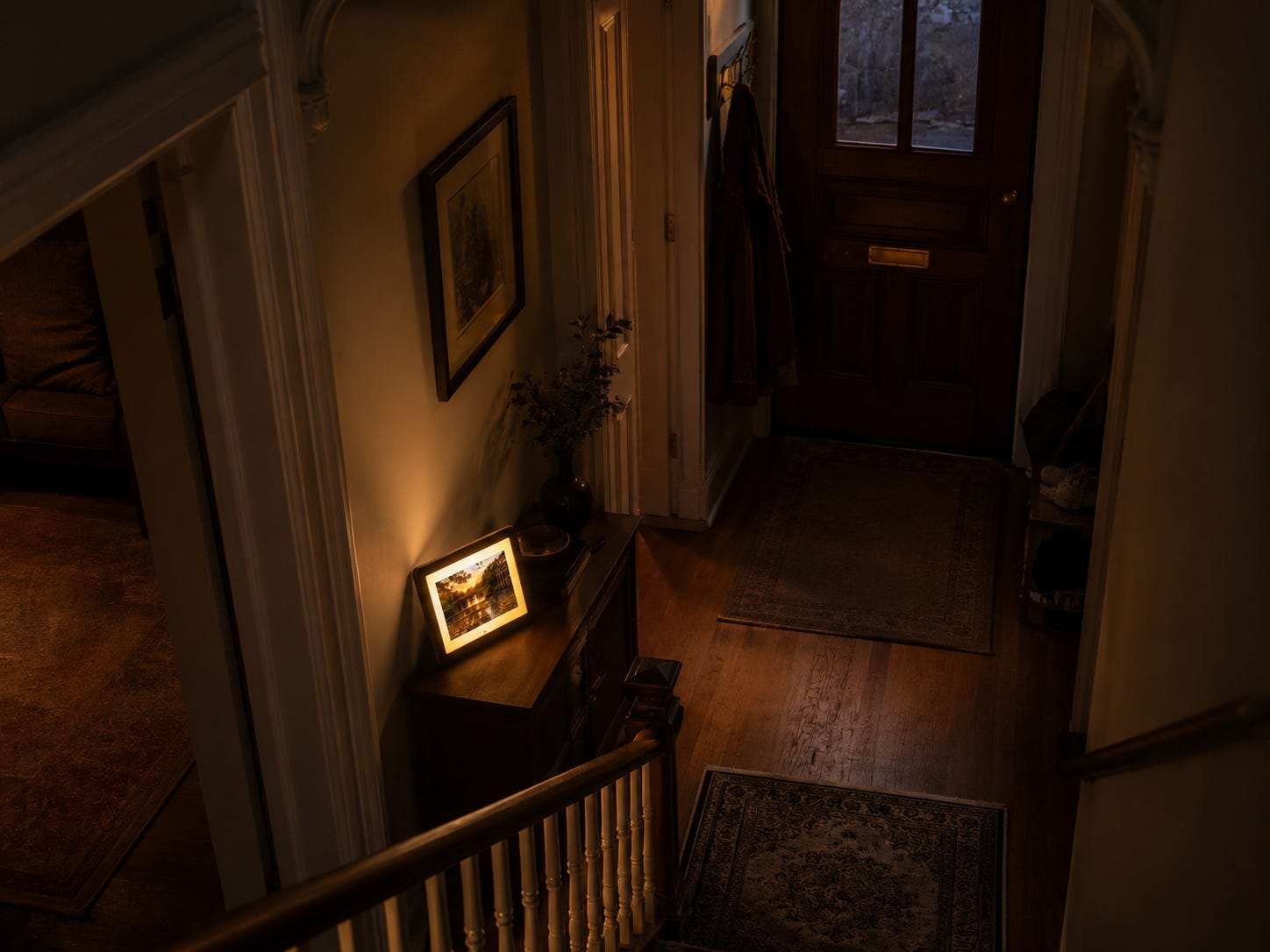
A few days later, as I was walking down the stairs, I caught Ella staring at the digital photo frame in our hallway. It was not an unusual sight. Over the years, I had caught both kids standing there from time to time, watching the reel of their lives move across the screen—ordinary afternoons elevated into evidence because a phone had been nearby. But on this day, the frame had paused on a picture from that other life. It’s one of my favorites. She’s standing in an open field inside Prospect Park on a bright fall day beside another toddler she sometimes encountered in the park. The other girl is looking off pensively. Ella is squealing in delight, all cheeks and motion and open-mouthed joy.
Beside me, the girl from the photo now had her own jokes, her own grievances, and a whole private world forming behind her eyes. She looked at me. Then she said, simply, “I remember that day.”
Ella’s memory has always had a stubborn, independent quality, which I imagine is not unusual among children her age. Nonetheless, in our family, we joke that she has a sticky brain. Things attach to her and do not easily come loose. She remembers promises adults barely remember making, what exception was granted one time and therefore must now be treated as precedent. Out of the blue, she recalls the flavor of ice cream she had on a field trip three years earlier, who said what on the bus back to school, which parents chaperoned, what someone wore, what was unfair, what rule was bent. She holds onto details that do not flatter anyone’s preferred version of events.
But when it comes to our shared history, how do I know what belongs to her and what belongs to me? When she is looking at a picture of herself as a toddler, how do I know whether she is retrieving an experience or returning a story I have given her so many times that it now feels like her own? Parents do not only preserve memory. We can also colonize it. We can hand our children our version of an event with such warmth and repetition that they begin to carry it as if it originated inside them.
Yet, looking at her profile against the glow of the glass, I had a thought that shocked me as both outrageous and entirely plausible. Was I witnessing the direct, physical effect of this device on my daughter’s memory? The frame had been mounted in the entranceway since the very first week we arrived in DC; she had known it as a daily companion since the day we moved, an unceasing and ever-expanding background presence through every transition of her childhood. Was it possible that the machine was doing something to her mind that nature hadn’t intended? Is this what happens when a child grows up alongside an archive of herself?
III. The Science of the Vanishing
Long before I knew anything about childhood amnesia, I knew Proust. I knew the awe of encountering a writer who seemed capable of reaching backward through time with a specificity that felt supernatural. Until I encountered Proust, I never knew that writing itself could take a taste, a room, a street, and use it to open an entire buried world. Reading him, I remember feeling incredibly intimidated, and yet equally inspired. How does a person remember that much? How does a childhood remain accessible with that level of detail? How does a mind hold the thread intact long enough to trace back so many origin stories?
My own early life is like seeing a bright sky through a throng of leafy trees. I catch glimpses depending on the direction of the breeze. Some I am confident are actual memories while others may be photographs I have looked at enough times that they are as likely to be impersonations of memory as the real thing.
The name memory researchers use for the disappearance of memories from our earliest selves is “childhood amnesia”. It sounds clinical, but it’s an attempt to name something as peculiar and baffling as the feelings that emerged when I re-entered Prospect Park for the wedding. Most adults cannot retrieve autobiographical memories from infancy and early toddlerhood, even though those years happened to us. It’s not as if we weren’t there. Our bodies traveled through space and time. We were fed, we were held, we felt fear and delight and soothing. We learned faces and voices and smells, and even routines. The past does not feel gone so much as sealed off. We stand before the heavy fabric knowing there is a backstage, but unable to find the center split. We lose access to those earliest years, leaving behind a cognitive riddle we still have not solved, even as conditions like dementia sometimes suggest that the past may remain lodged inside us in cobwebbed corridors.
For over a century, we searched for explanations for this phenomenon. Sigmund Freud gave childhood amnesia its first great drama. The good doctor, as he was wont to do, imagined the earliest years as a zone of repression and forbidden knowledge that presented dangers to the adult psyche. But as the twentieth century entered its third decade, Jean Piaget and the developmental psychology tradition he gave shape to recast the child’s mind into a construction zone, gradually acquiring the capacities that make adult thought possible. They in turn redirected the search for clues out of the unconscious and into the architecture of the growing brain. And as researchers learned to study children directly, they asked a different kind of question about memory, one that reflected a different era’s understanding of the human being. What must a child possess for experience to become autobiographical memory?
For a long time, the most satisfying answer was that the infant brain simply was not ready. The child lived through experience, but the mind lacked the neurological, linguistic, and narrative maturity necessary to organize that experience and encode it as durable autobiographical memory. The camera was on, but the record button hadn’t been pressed.
Beginning with her first experiments in the late 1960s, a developmental psychologist named Carolyn Rovee-Collier began exploring a different question. She was interested in infant learning and memory. Working first at the University of California, Davis and later at Rutgers, she designed a series of experiments so simple they almost seem obvious in retrospect. An infant lay beneath a mobile (think: mechanical baby toy) suspended over a crib. A ribbon connected the mobile to the infant’s ankle. Before long, the baby discovered the relationship: kick and the mobile moved. The baby kicked. The mobile danced. The baby kicked harder.
Days later, sometimes weeks later, Rovee-Collier invited the families back and recreated the conditions of the original experiment. And, remarkably, the infants behaved as though they remembered. Was it rudimentary? Sure. But at the time, it was an enormous breakthrough. If infants could remember days later, and more mature infants could remember weeks later, then the old construction zone certainties became harder to defend.
By the early 2000s, psychologist Patricia Bauer had returned squarely to the question of childhood amnesia. If the old certainty that infancy was a kind of cognitive blank slate had crumbled, what then explained why adults could not remember most of the earliest years of their lives? She was interested in the conditions that allowed an experience to survive the journey from infancy into later childhood; what caused it to disappear; and why some traces held while others faded.
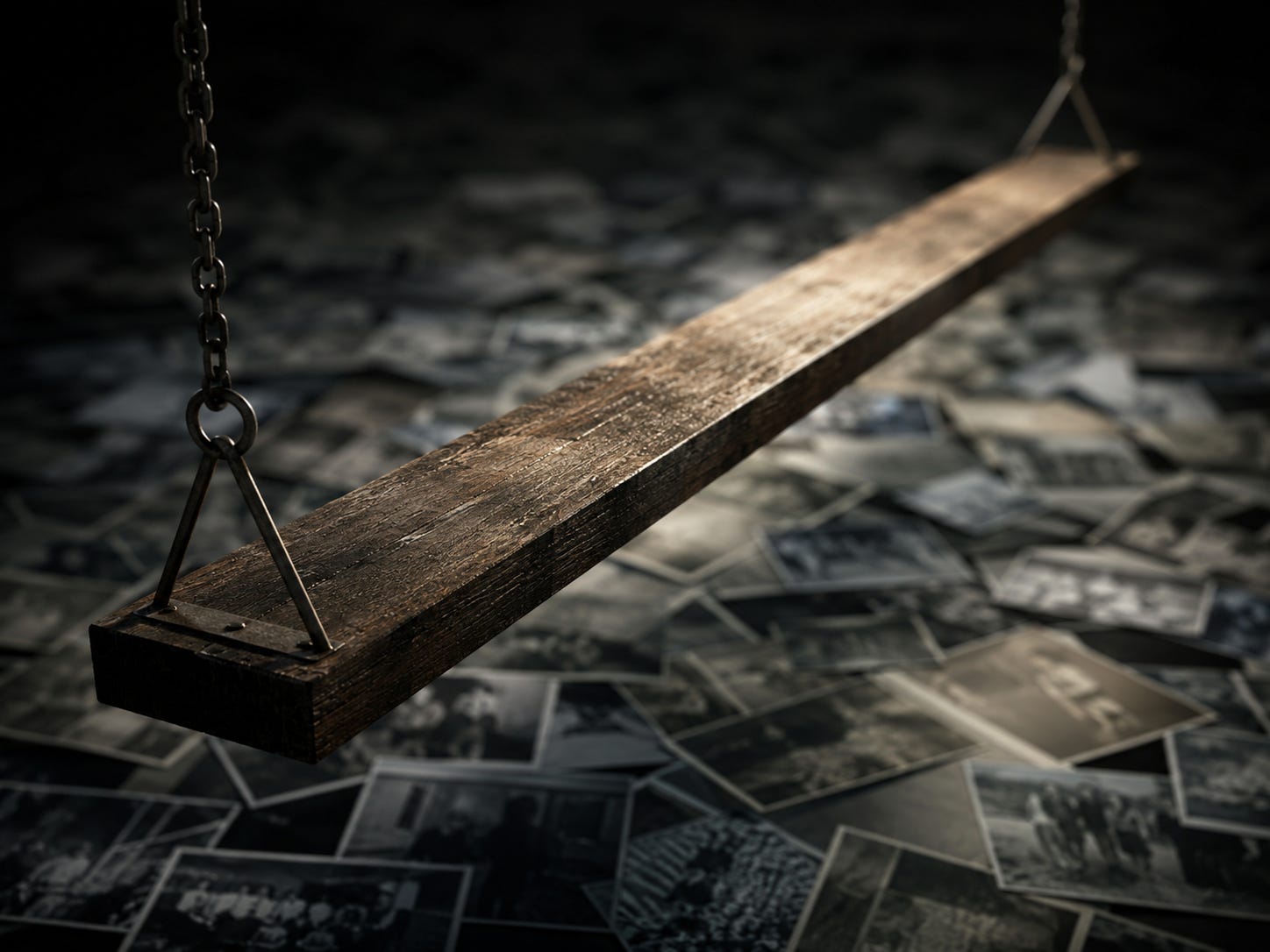
In a 2005 interview, Bauer, who was then at Duke but has been at Emory since 2007, described early memory with a highly relatable metaphor, suggesting that retaining a recollection is like walking a balance beam. Adults have mature cognitive systems; we are not perfect, but we possess the footing to steady ourselves when time, distraction, or new experience knocks us slightly off center. A very young child does not have that stability yet. The slightest disruption can send the memory off the beam entirely.
In her 2007 book, Remembering the Times of Our Lives, Bauer mapped this exact stability problem, treating remembering and forgetting not as mechanical flaws, but as paired developmental processes. Early childhood is a period when it is inherently difficult to remember and easy to forget because the cognitive tools required to keep an experience on the beam are still under construction. The traces that disappear are simply those that lose their footing and slip away before those internal tools can arrive to hold them in place. The memories that survive do not simply remain intact. They are reshaped as the child grows.
For generations, psychology had often treated early memory as an all-or-nothing proposition: either the infant mind recorded the raw data or it did not. Bauer shifted the focus from a fixed archive to a dynamic construction site. She mapped the cognitive supports a child needs for experience to become autobiography: a stable-enough concept of self, a developing grasp of time and sequence, and the narrative framework of language. Without those tools, experience may still enter the child. It may even remain for a while. But it has nowhere stable to live. Childhood amnesia, then, is both a storage problem and a stability problem shaped by the cognitive structures a child is still building and by the biological drama unfolding beneath them. While the mind is assembling the scaffolds of self, time, and language, the physical brain is also pruning, growing, and reorganizing.
But it was a later longitudinal study, published by Bauer and her Emory colleague Marina Larkina in 2014, that turned the science into something closer to a countdown. If early memory was like a child trying to cross a balance beam, Bauer and Larkina wanted to know when the wobble became a fall. At what age did memories that had once been available begin slipping off the beam?
They recruited mothers and their three-year-old children and invited them into the ordinary intimacy of remembering the lived material of early childhood together. The parents were asked to talk as they normally would, to sit with their children and return to shared experiences in conversation. Then the researchers waited.
Over the next several years, different children from the study returned at ages five, six, seven, eight, and nine. Bauer and Larkina listened for what had survived and what had already slipped beyond reach. The children interviewed at five and six could still recall many of the events they had discussed at three. The memories were not perfectly preserved, but many were still on the beam. By seven, the children appeared to be approaching the cliff. By eight and nine, far fewer memories remained within reach.
So, the good news was that childhood amnesia was not a done deal, a closed chapter from a time before Ella could even form sentences, strengthening the case that she did, in fact, remember Brooklyn. The unsettling realization was that Ella had just turned seven, and according to the research on childhood amnesia, the cliff was scheduled to be happening right now, in real time, while she was laughing, while she was interrupting me to correct a story, while she was stubbornly insisting on what she remembered. The balance beam was still there, and it was actively shaking under her feet. But somewhere just ahead was the ledge where they would fall out of reach forever. The Brooklyn we shared—the stroller rides, the paths through the trees, the panic of 2020—isn’t safely locked away in a vault inside her brain, waiting for her to grow up and discover it. It’s on the line right now.
That recognition sent a jolt of desperation into my search for answers. All at once, I was looking at Ella and wondering whether the child who had lived on Empire Boulevard was on the verge of being left behind on that other earth for good. Yet inside the quiet terror of that timeline, Bauer and Larkina’s data offered an unexpected loophole. The cliff was real, but it was not entirely unyielding. Some memories survived the crossing better than others, and the one variable that seemed to affect whether those memories remained reachable at all was how mothers had talked with their three-year-olds years earlier.
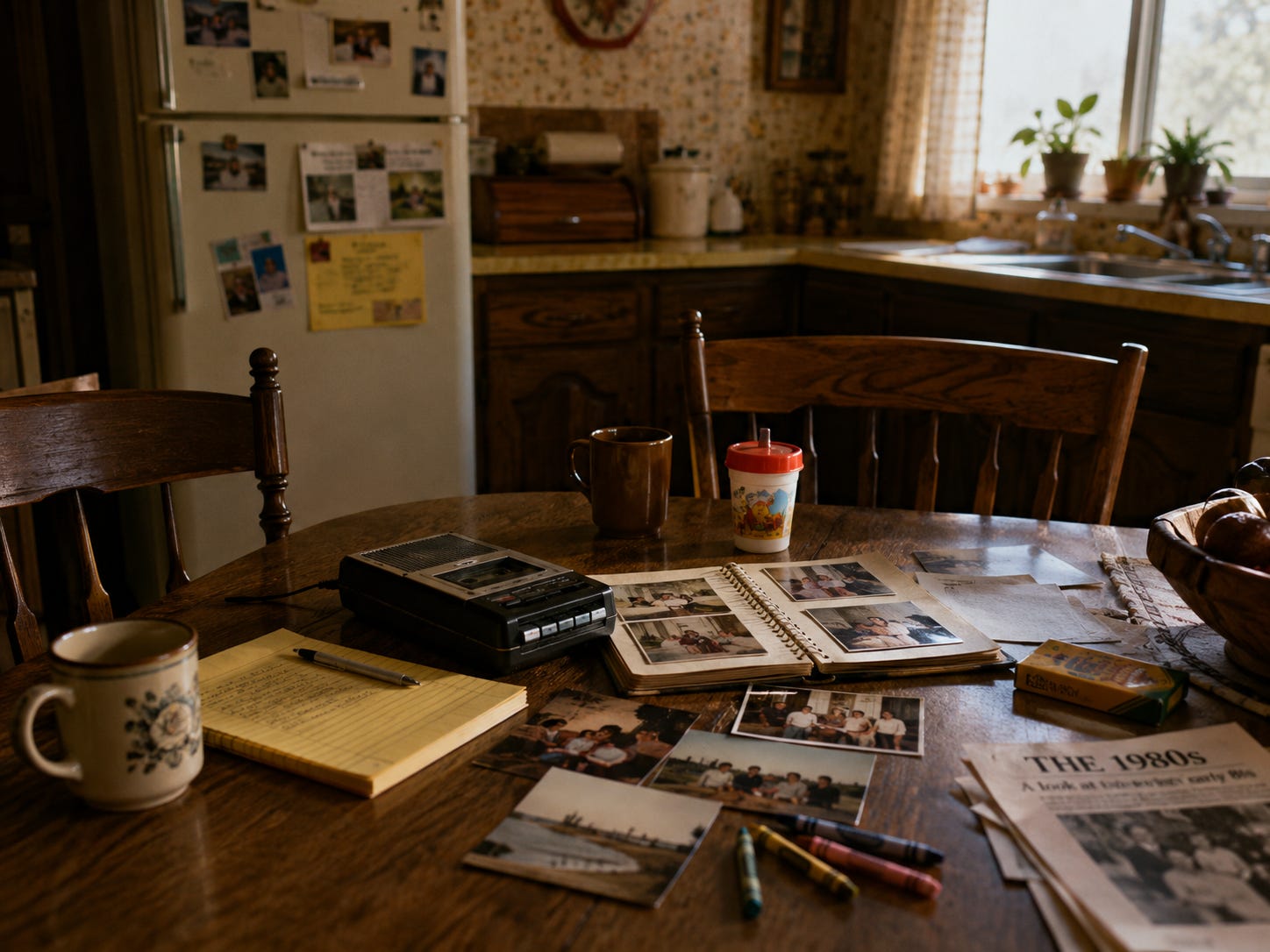
Bauer and Larkina were actually pulling on a thread woven by an earlier generation of researchers. Starting in the 1980s, a cohort of developmental psychologists—including Katherine Nelson, Robyn Fivush, and Elaine Reese—began challenging the romantic assumption that a memory must originate inside a child alone to be authentic. They went into ordinary homes, recording and micro-analyzing thousands of hours of mundane, kitchen-table conversations between mothers and toddlers talking about recent events. Through these recordings, they established the socio-cultural model of memory, showing that human recall is actually born out in the open.
Their work pushed against the idea that adult influence somehow contaminates memory’s purity. The roots of this purity test run through a long lineage of philosophy and psychology that taught us to imagine the self as something most true when left untouched. Jean-Jacques Rousseau, the eighteenth-century philosopher whose writings, particularly Emile, helped popularize the idea of childhood as a state of natural innocence corrupted by society, gave us one version of the sacred child. Freud gave us the image of the buried psychic chamber, where early experience remains hidden but alive. Across these traditions, the inner life takes shape as a private archive waiting to be recovered. Over time, we inherited the conviction that memory is an internal artifact, and that outside influence is a form of contamination.
But autobiographical memory, these women argued, does not develop that way. We may tend to imagine a child living through an experience and filing it away intact in some private internal archive, waiting for the day it can be retrieved, but in reality, a child has to learn how to translate raw experience into durable memory, and much of that learning happens in the small talk of ordinary days. A parent asks, “Remember when we went to the beach?” The child offers a fragment, and the parent fills in the frame. They add a detail, prompt the next beat, name the emotion, establish the order of events. The exchange may appear disposable, but it is actually foundational. The adult is handing the child the structural template of a life story. Elaborative storytelling is one of the engines that makes autobiographical memory possible. It supplies a stabilizing frame before the child can build one alone.
In the years leading up to Bauer’s work, Cornell psychologist Qi Wang showed just how deeply this conversational framework shapes the very timeline and structure of our personal history. By tracking European American and Chinese children from preschool through the second grade, Wang demonstrated that the onset and accessibility of the autobiographical self are remarkably elastic. In her cross-cultural studies, Western children—immersed in highly elaborative, self-focused parental talk—reported their earliest childhood memories anywhere from six months to over a year earlier than their East Asian counterparts. When asked to recount their past, the Western children provided dense, specific, emotionally detailed narratives centered on their own roles and preferences. Raised in environments that emphasized collective harmony and shared routines, the Chinese children offered far more skeletal, relationally oriented accounts. The way a community talks to its children turns out to be a primary architect of the inner life.
For those of us still attached to the idea that memory is most authentic when left untouched, this collaborative process introduces an inevitable complication. When adult storytelling helps preserve a child’s memory, it also enters the memory, determining its shape. Protection and construction happen at the exact same time. A mother asking, “How did the water feel?” is helping stabilize a fragile day, but as Wang’s work makes clear, she is also passing down a specific cultural theory of what matters. The question does not just help keep an event on the beam; it actively guides the child toward a definition of who they are in relation to that event. It carries emphasis, feeling, and a blueprint for identity. Scaffolding is a natural architecture, but it is never neutral.
What made Bauer and Larkina’s work so powerful is that they took this social theory of memory and put it to use at a specific developmental threshold: the dangerous crossing between early and later childhood. They tracked which pieces of the past survived, and their findings suggested that a shared story could act as an active defense system against childhood amnesia.
By the time I had followed this trail from Freud’s buried chamber to Bauer’s balance beam, from mother-child storytelling to Wang’s finding that culture can shift the autobiographical clock, the scene at the bottom of my stairs no longer looked like a curious domestic mystery. The science had given it shape. If the human voice can act as a scaffolding system that holds a memory steady on the balance beam until our internal cognitive tools arrive to claim it, then perhaps the glass rectangle sitting on our entry table was not merely preserving memories. Perhaps it was a mechanical extension of that same process. Did it ask Ella what happened next? No. Did it help her sequence the day or tell her why the moment was worth remembering? Of course not. But by repeatedly placing Ella inside a visible story of herself, it was casting an automated, high-definition frame around a life that biology might otherwise leave behind.
IV. The Technology That Finally Took
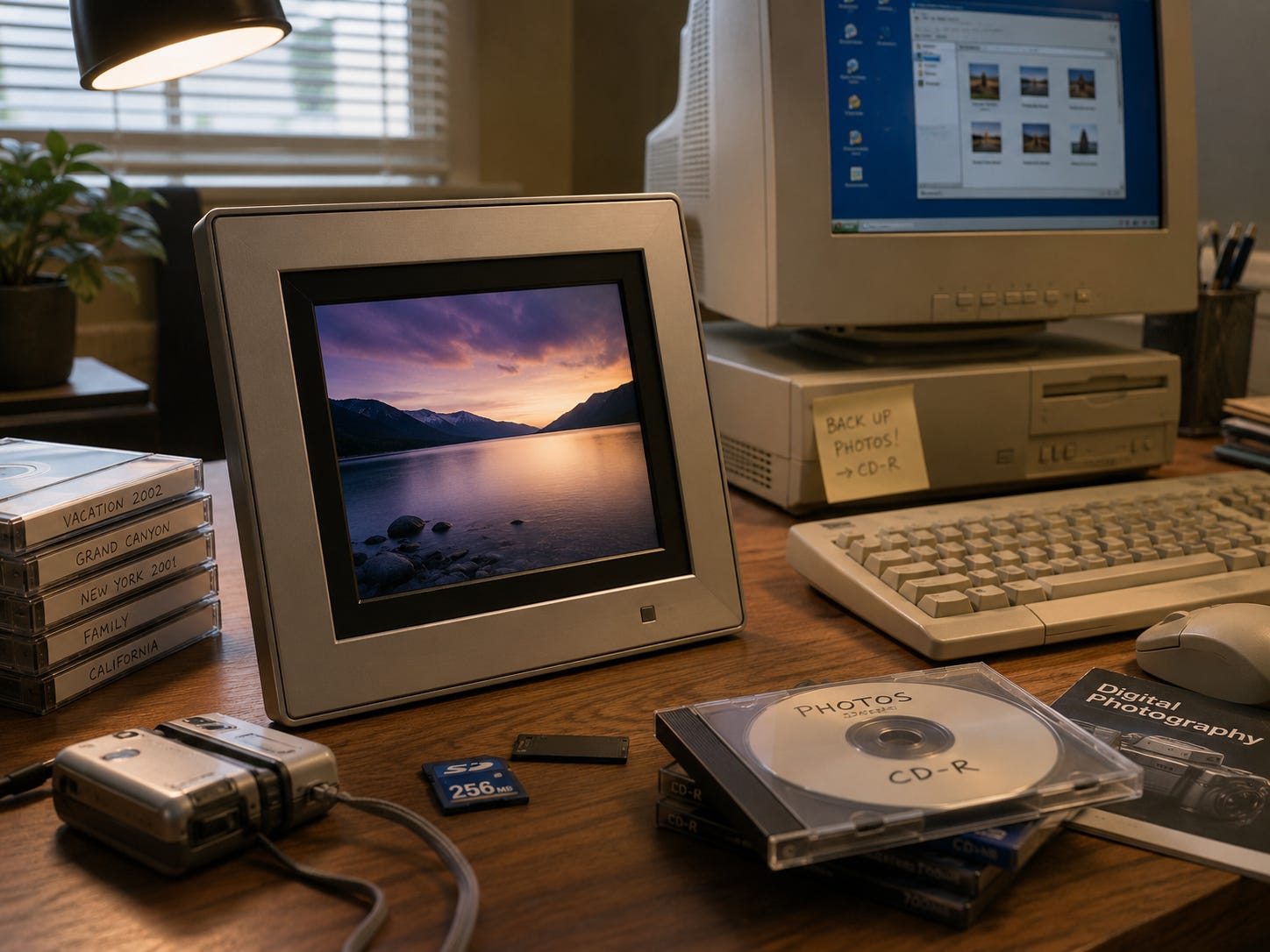
The digital photo frame actually arrived long before the world was ready to know what to do with it. It first emerged around the turn of the millennium as a premature solution to a brand-new paradox. The digital camera had arrived, but we suddenly had nowhere to look at our pictures. The old photography infrastructure—the film canister, the drug-store development envelope, the lumbering photo album—was dying, while the new world lay blinking under the bright lights of the delivery room.
We survived this interstitial era by storing our lives on physical objects that held expanded but strictly bounded capacities. We archived our lives by burning photos onto gold-tinted CD-Rs and labeling them with Sharpies. We packed our home videos onto DVDs, slipped them into plastic jewel cases, and eventually upgraded, ever so briefly, to Blu-rays. It was digital, yes, but it was still media you had to hold in your hand, store on a shelf, and physically protect from scratches.
The first generation digital frames that arrived in this period were defined almost entirely by friction. Sony called its first model the CyberFrame, a name that now sounds like it was loaded slowly from the era of dial-up internet, translucent plastic, and earnest corporate belief that the word “cyber” could make anything feel futuristic. The product was not ridiculous so much as the process for using it was arduous. To get a photo onto the screen, you had to manually eject an SD card or a long, proprietary, chewing-gum-shaped Sony Memory Stick from the side of your camera. Then you had to slide it into a multi-port adapter dangling from the back of a beige tower PC, wait for the desktop to mount the drive, and drag over a handful of low-resolution JPEGs. Then, after all of that, you took the card back to the hallway and plugged it into the frame.
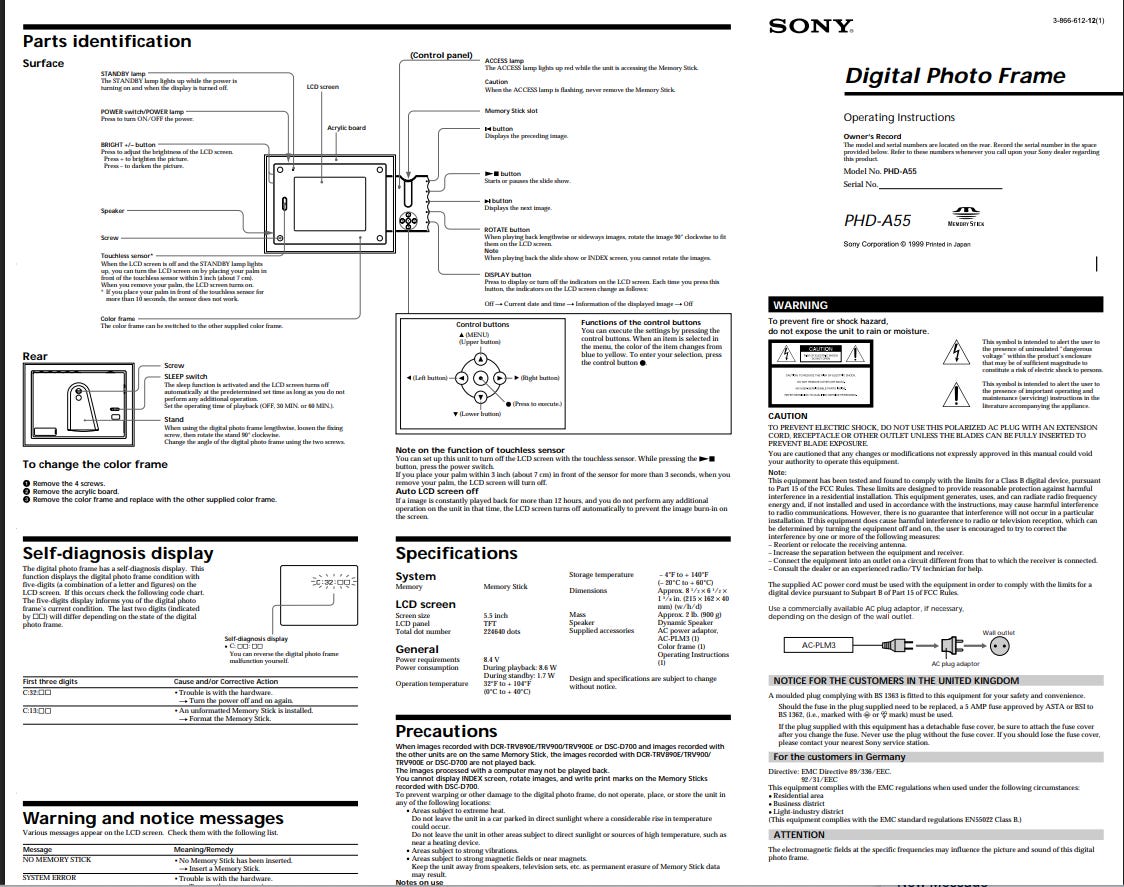
Consumer enthusiasm was not built to sustain such a chore so the frames were unplugged and shoved into hall closets, or worse, left running, frozen into automated monuments to a single Thanksgiving or a blurry beach trip because nobody in the house cared enough to update the plastic stick. The technology had arrived too early. It needed to hibernate and wait for the rest of the world to catch up.
Meanwhile, as those early frames gathered dust in the dark, the technologies that would one day rescue them were traveling a strange parallel track with the science of children and memory. Then, in 2007, the frame’s second life came into view. The same year Patricia Bauer gathered a generation of research on why early memories form, fade, and fail to endure in her career-defining work, Remembering the Times of Our Lives, Steve Jobs stood on a stage and introduced a device that would help transform photography from an occasional act into a condition of daily life.
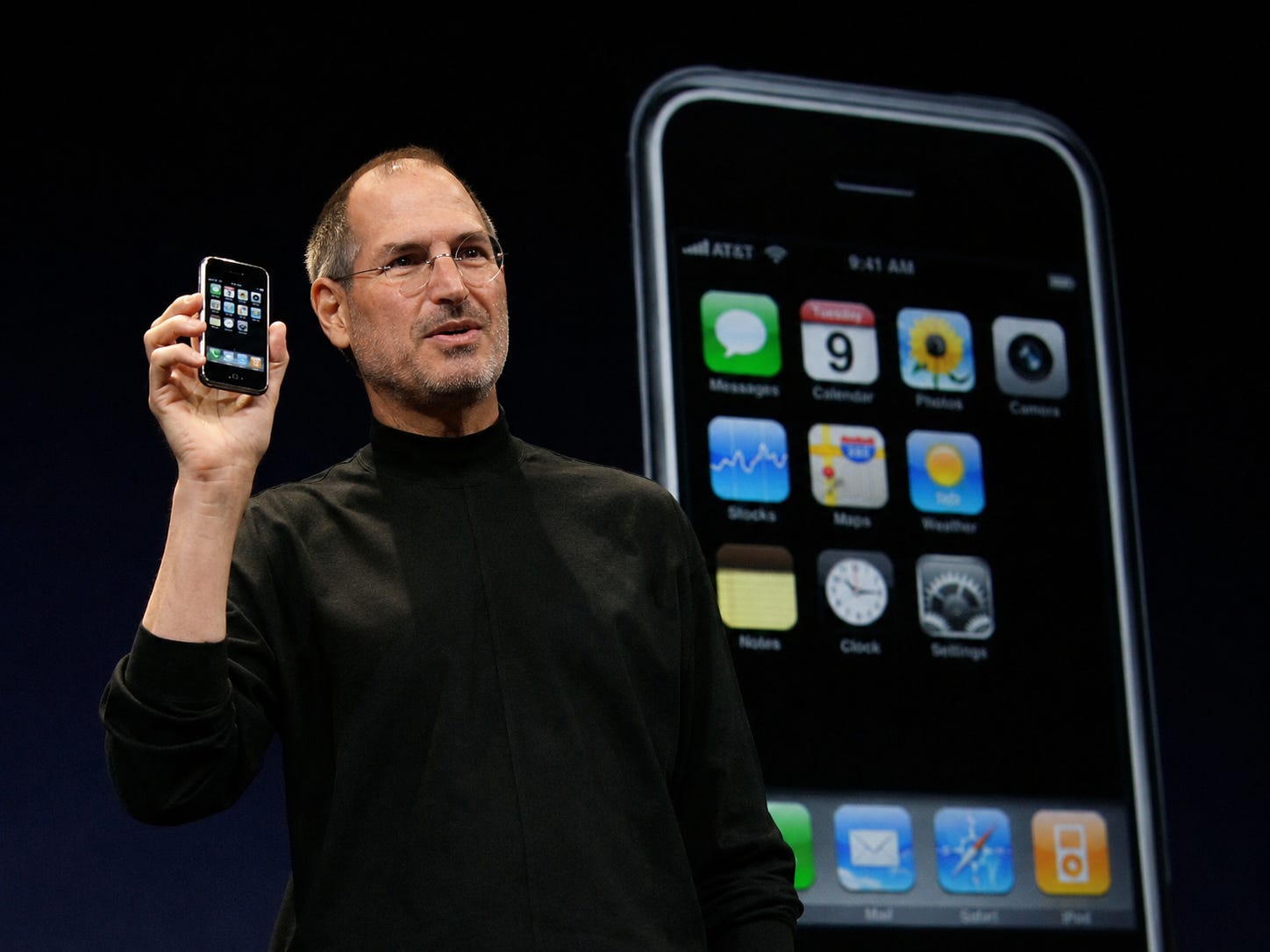
Once the smartphone put a camera in every pocket, the volume of images exploded. Photography was no longer reserved for birthdays, vacations, graduations, and the occasional roll of film someone remembered to develop. It became ambient, reflexive, daily. We were capturing more of life than ever before, which meant we suddenly needed somewhere for all those images to go.
But even the iPhone did not, by itself, send us digging through the closet for the digital frame. If anything, the years that followed made the frame’s identity even less certain. In January 2010, the iPad arrived and seemed, briefly, like it might put the finishing touches on the frame. Why buy a dedicated screen for photographs when a tablet could do everything? The digital frame faced a second humiliation. First it had been too early. Then it seemed redundant.
But the tablet never quite fulfilled the promise of the photograph in the house. A tablet could display family photos, but it had bigger ambitions than being a frame. The iPad aspired to be a portal to everything, an object you could never leave idle without rendering your life incomplete. And that may have been the strange gift the iPad gave the frame. It was not a general-purpose screen, not a computer. Its purpose was more specific and, for that reason, more intimate. It was meant to sit still and make the past present without requiring anyone to go looking for it.
Still, one problem remained. Once a camera became something we carried everywhere, we had to figure out where all those photographs would reside. Enter the cloud. Suddenly, the physical ceiling of memory storage began to lift. We no longer had to delete, choose, or forget simply to make room for tomorrow. The shoebox, the shelf, the binder, the CD tower, the hard drive groaning beside the chunky monitor: all were relieved of their old duties and demoted to nostalgia. With the cloud in place, the digital frame found its true calling, returning to showroom floors as a wireless window hooked directly to an invisible reservoir in the sky. The iPhone had captured the raw material of our days, the cloud had removed the old pressure to erase and now the modern frame brought the archive back down from the ether to mount it in our homes.
For all their ingenuity, the engineers were solving for display, storage, compatibility, and ease. For corporate leaders and shareholders, the objective was consumer consumption. Neither group was solving for childhood amnesia. They were not asking what happens when a young child passes the same glowing archive every day, while the cognitive scaffolds of self, time, and language are still finding their footing. They were not asking whether a machine designed to rescue photographs from hard drives might also rescue fragments of a child’s early life from biological forgetting.
The memory research recast the device entirely.
If early memory is a stability problem, if shared story can help stabilize a child’s past, and if the autobiographical self is shaped by the surrounding culture of narration, then the frame was not merely showing pictures. It was augmenting the conditions under which my daughter came to know herself as a person with a past.
At first, that felt miraculous to me. After learning how aggressively biology can carry the earliest years away, how could I not feel some gratitude toward the machine that kept bringing Brooklyn back?
Yet it was cultural theorist Kate Eichhorn who helped me see the other side of the bargain. In her 2019 book, The End of Forgetting, Eichhorn argues that digital media have imperiled one of the subtle freedoms earlier generations could easily take for granted: the ability to leave childhood behind. In the analog world, a humiliating photograph could be slipped from an album and destroyed. A phase could fade mercifully out of view, becoming unavailable, not only to others but eventually to oneself. Digital media means childhood no longer disappears so easily. It lingers, circulates, resurfaces, and in many cases belongs to platforms, networks, and other people’s collections as much as to the person who lived it.
Eichhorn is mostly concerned with the ways social media interacts with adolescence, making it difficult for young people to escape their documented pasts. My disquiet begins earlier, in the hallway, before the child is old enough to post, tag, curate, or consent. While Eichhorn focuses on the difficulty of escaping a documented adolescence online, her warning about stolen agency applies with equal force to the machine on my wall. The frame may not be broadcasting Ella to the world, but it is continuously returning her to herself before she has fully decided what self she wants to claim. Moreover, even as the miraculous device may be helping Ella hold onto Brooklyn, it may also be interrupting a natural, healthy cognitive process.
Indeed, contemporary neurobiology has begun to map the exact physical mechanics of that process. In tracing how we navigate our personal histories, Eichhorn points to a fundamental shift in how science views the internal archive. When neuroscientists Donna Bridge and Joel Voss monitored brain activity using MRI scanners, they found clear biological evidence that the brain is not simply a recording device holding memories intact—it actively edits them. The hippocampus, the region deeply entangled in our personal history, allows current information to systematically update past experiences. Based on these findings, Bridge and Voss proposed that this kind of systematic overwriting is too pervasive to be an accident; it must serve a specific, vital function. That revision may in fact be one of forgetting’s most important purposes. Meaning, forgetting is not merely memory’s failure or enemy—a problem to be solved. It can be mercy, adaptation, revision, release. It allows the present to infiltrate the past, deleting or softening what no longer serves us and reshaping what remains into something we can actually carry forward.
And that internal revision was never just happening to Ella; it was happening to me. I had begun this exploration inside my own unexamined grief, mourning a chapter in Brooklyn that ended so abruptly I never gave myself the space to lay it to rest. We left that city in a rush because I could no longer stand the horrors of the pandemic—the sirens, the silences, and that endless repetition of days I just wanted to escape. But distance and the steady ground of a new life eventually change the terrain. Somewhere in the years since we left, my own brain has been executing its own updates, letting the present filter into the past until the sharpness softens and the story shifts shape. I have been revised into someone who can finally look back at what we left and see it without needing to flee it all over again.
Perhaps that is why the frame in the hallway has always felt so heavy. It is not only asking Ella to remember Brooklyn; it is asking her to meet me there. Part of me wants her to remember the stoop, the park, the rooms, and the walks because I am finally capable of holding that life, and I want us to hold it together. But if memory is an act of ongoing revision, then Ella deserves the right to revise too. She deserves the power to keep what is hers, release what is not, and refuse the parts of her past that the rest of us may still want her to carry.
Not long after the hallway interaction, I saw that power in full relief. I had pulled up an ultrasound image from before she was born, one of those frighteningly clear fetal portraits many parents keep and occasionally present as proof of continuity. There she was, or so I believed: the curve of the profile, the nose, legs gently crossed, the distinct pucker of the mouth I would later know. I showed it to her with the confidence of a father offering an heirloom.
“Look,” I said. “That’s you.”
She studied it for a moment. Then she turned away.
“I don’t want to see that,” she announced flatly.
The whole exchange lasted maybe sixty seconds, but the message was indelible. Whatever tenderness I felt toward the image, whatever awe I had attached to it, whatever proof I believed it offered, she wanted no parts of it. This was not a memory she wanted. It was not her memory at all. It belonged to me, to Alana, to the medical archive, to the strange parental hunger to say, You were here before you knew you were here. So she rejected it.
And strangely, once the door shutting in my face feeling faded, I took comfort in that. Ella was doing something of her own. She was declaring that she is not simply a dumping ground for all our data collection obsessions. She was not merely an object of memory, technology, parenting, or culture. She was developing a will.
The digital frame may be changing the conditions of forgetting. It may be giving certain images more staying power than biology alone would have granted them. But even inside that architecture of relentless recall, she is not passive. She is selecting. Rejecting. Turning away. She is deciding what has a claim on her and what does not.
So when Ella stood in the hallway and told me she remembered that day in Prospect Park, maybe the frame had helped. Maybe my stories had helped. Maybe biology had allowed one small plank of the bridge to remain. I do not know. But I know this: when I showed her the image from before memory, she refused it. And maybe that means she is not only being taught to remember. Maybe she is also learning how to choose what is worth remembering.